PEDs. Again. Yeah.
What the fuck do you say about this guy now? Conor McGregor acts like the supreme asshole of the sport, but Jon Jones holds the actual title. There's no dick pill excuse on this one. If he did get another tainted dick pill, his suspension should be even longer on account of sheer idiocy.
Everything about this feels bad. I can't even be happy for Daniel Cormier having the title come back to him, because no matter the level of cheat, we saw him get busted up twice by Jones and, at his best, keep the fights even. I want to believe, deep in my soul, that an un-juiced Jones gets hammer fisted into next month by Cormier, but that only feels like it would be true if Jones had been juicing his entire career, even when he wasn't making the money to afford these suspensions (or maybe even the drugs).
Cormier deserves to hold the title, assuming this isn't some sort of borked test. He's the best light heavyweight in the world, by some margin, out of everyone who follows the rules. But it's also possible to recognize someone as a deserving champ while having it not quite seem like he's cleared every hurdle. It's not as though this is a singular problem for him, mind you; with regards to public perception, this idea is applied to other people as well. There's a difference between someone viewed as merely holding a belt (Michael Bisping), someone who might have deserving challengers but none who people think are on his or her level (Max Holloway), and someone who has completely cleared out a division (Demetrious Johnson).
But the whole point of the second Jones fight was for Cormier to prove, if he won, that he was truly the best and could beat all comers. Even knowing intellectually he was fighting a version of Jones that was not allowed in the Octagon, the sense is still there that Jones remains an uncleared hurdle. Justice in this sport would be never seeing Jones fight for a UFC title again. Even if he does, it wouldn't happen until Cormier is likely retired. Thus Cormier, unlike anyone else, will continue on without ever having a chance to implant himself as a champion in people's minds in the visceral way they need to see to really, truly believe it.
And that just fucking sucks.
Tuesday, August 22, 2017

Sunday, August 20, 2017
So What About This Defenders Show?
It's OK.
I wanted it to be better, which is a pretty dumb statement, because anybody who thinks a thing is only OK will want it to be better. I certainly expected it to be better. What I expected more than something better, though, was something longer.
Here's a reminder of the episodes coming in for the core characters:
I wanted it to be better, which is a pretty dumb statement, because anybody who thinks a thing is only OK will want it to be better. I certainly expected it to be better. What I expected more than something better, though, was something longer.
Here's a reminder of the episodes coming in for the core characters:
- Daredevil: 26 episodes (thirteen each season)
- Jessica Jones: 13 episodes
- Luke Cage: 13 episodes
- Iron Fist: 13 episodes
Getting the idea? They've had a method for doing these shows so far, and it's worked (except for Iron Fist, but there's no correct number of episodes that could make Iron Fist good), so the expectation was another thirteen. Maybe twelve. But eight? How do you properly approach a series with four main characters using less than two-thirds the total screen time than each of those characters had to themselves?
I don't know, and apparently the Marvel writers didn't either. It's not some bleak catastrophe of a show that will make you question the hours you spent watching, even if watching meant keeping it in the corner of your eye while you multi-tasked three different things on your second monitor. On the other hand, I thought Iron Fist was average rather than terrible, and this isn't even as good as Iron Fist, so maybe it is a giant dogpile.
If you saw the other four series and were expecting the characters to be similar, you'll be half-right and probably a quarter-pleased. Jessica Jones doesn't stop cutting down everyone and everything around her, and Danny Rand is the same self-indulgent little prick who doesn't know one-third the shit he thinks he does. But Daredevil won't shut the fuck up about Elektra, and Luke sets a fucking world record for rate of good guy cliches uttered in a single television series.
(Interlude where I speak to Luke Cage as if he's a real person: Luke. My man. You're a good dude. Maybe you're even a great dude. Everyone appreciates how willing you are to protect the people of Harlem and the city of New York. Everyone also knows by now how willing you are to protect them. Stop fucking telling us.)
It doesn't help that the story centers on Iron Fist (side note to Danny Rand: we also know you're the Immortal Iron Fist, stop telling us that too). The other three are all capable of personal crises far more interesting than his shit. It is understandable, though; he was the only character with an enemy that ranged beyond New York City. Putting a team of heroes together can very logically lead to using the biggest enemy currently in play. But that's why it needed more than eight episodes to finish the story properly. If this Defenders season had a story designed to spread back out into the single-character series and/or season two, that would be one thing--that thing being more than eight episodes--but it's not anywhere near enough to both give the characters any of the depth we expect from their individual series and carry the type of battle at hand here.
This has already been too many words for this show. It's OK. Meh.
Saturday, August 19, 2017
Mayweather vs. McGregor: Prediction
Mayweather wins.
That was easy. The biggest question mark surrounding this fight is how so many people were convinced McGregor has enough of a chance to win that they were willing to put money on it.
It made some sense under the original odds; at +950 for McGregor and -2000 or worse for Mayweather, it was hardly worth betting on Floyd at all. The ROI at -2000 in a fight where the other guy has a puncher's chance is complete shit. So anyone who felt a burning need to put money down were only incentivized to bet on McGregor. What the hell, right? If I have fifty bucks I don't need and a miracle might turn it into $500, and I have the chance to say I believed in McGregor enough to put that money down if he does somehow win, it might be worth taking a flyer on it. Thus the movement of the betting line towards McGregor was inevitable.
The extent to which that's the case is a different story. One week before the fight, Mayweather's down to a -450 favorite, with McGregor at +325. A +950 line means approximately 10:1 odds; McGregor has to have at least a 10% chance of winning the fight to make the bet break-even. To give McGregor that much of a chance against the greatest boxer of the last two decades is a hell of a stretch at best, but those are the best odds you'll get, so jump on them when you can. Pretty quickly, however, only stupid money follows the semi-smart. At what point is a McGregor bet clearly a losing proposition, no matter your belief in his youth and the hope his striking power can translate to boxing? +700? +500? What argument can support McGregor having a legitimate one in five chance of beating Floyd goddamned Mayweather?
More over, when does Mayweather start becoming worth the money? Or when did he, since he clearly is at this point? Right now, you'd have to put down $450 to win $100. It's still mainly a bet for serious gamblers, the ones who place enough bets to withstand the variance of surprise outcomes; it's harder to justify risking $450 per $100 profit on a one-off. That doesn't change the fact that Mayweather, at these odds, is an incredibly good value.
Here's part of an overheard conversation about the fight: "If McGregor goes twelve rounds with Mayweather, that's going to prove MMA is for real. It'll be huge for the sport." That guy could end up being right, but if he is it won't have anything to do with McGregor proving something about his sport by going the distance. It will be McGregor and Dana White cranking the hype machine up to thirteen letting people know what an accomplishment it was to last twelve rounds with the greatest boxer of his generation.
On any logical level, though, that's absurd. Why shouldn't we expect McGregor to last twelve rounds? Have all the people predicting a Mayweather knockout because his skill level is so much higher forgotten his last knockout (apart from Victor 'Gimme A Hug' Ortiz) came against Ricky Hatton in 2007?
If anything, a Mayweather KO would logically prove how different boxing and MMA are. Conor McGregor is an extremely high-level combat sports athlete with fitness to match, facing a man whose greatness is predicated on defense and counter-punching, and who has never shown any qualms about taking zero chances in pursuit of a victory. People talk about what McGregor has to do to knockout Mayweather, which makes sense given that it's his only reasonable route to victory.
Floyd Mayweather doesn't fight for knockouts, he fights for victories. He's an all-time great fighting a well-honed athlete who brings, at best, a low-level professional's skill set in this sport. The most likely outcome, given the track records of the fighters, is that Mayweather scoots around the ring for twelve rounds and McGregor is lucky to land fifty punches of any type all fight. The fact most predictions seem to revolve around a KO for one man or the other defies all logic.
And that's why Conor McGregor is, by the betting line, considered more likely to beat Floyd Mayweather than Marcos fucking Maidana was in the second Mayweather/Maidana fight. People are just goddamned silly.
That was easy. The biggest question mark surrounding this fight is how so many people were convinced McGregor has enough of a chance to win that they were willing to put money on it.
It made some sense under the original odds; at +950 for McGregor and -2000 or worse for Mayweather, it was hardly worth betting on Floyd at all. The ROI at -2000 in a fight where the other guy has a puncher's chance is complete shit. So anyone who felt a burning need to put money down were only incentivized to bet on McGregor. What the hell, right? If I have fifty bucks I don't need and a miracle might turn it into $500, and I have the chance to say I believed in McGregor enough to put that money down if he does somehow win, it might be worth taking a flyer on it. Thus the movement of the betting line towards McGregor was inevitable.
The extent to which that's the case is a different story. One week before the fight, Mayweather's down to a -450 favorite, with McGregor at +325. A +950 line means approximately 10:1 odds; McGregor has to have at least a 10% chance of winning the fight to make the bet break-even. To give McGregor that much of a chance against the greatest boxer of the last two decades is a hell of a stretch at best, but those are the best odds you'll get, so jump on them when you can. Pretty quickly, however, only stupid money follows the semi-smart. At what point is a McGregor bet clearly a losing proposition, no matter your belief in his youth and the hope his striking power can translate to boxing? +700? +500? What argument can support McGregor having a legitimate one in five chance of beating Floyd goddamned Mayweather?
More over, when does Mayweather start becoming worth the money? Or when did he, since he clearly is at this point? Right now, you'd have to put down $450 to win $100. It's still mainly a bet for serious gamblers, the ones who place enough bets to withstand the variance of surprise outcomes; it's harder to justify risking $450 per $100 profit on a one-off. That doesn't change the fact that Mayweather, at these odds, is an incredibly good value.
Here's part of an overheard conversation about the fight: "If McGregor goes twelve rounds with Mayweather, that's going to prove MMA is for real. It'll be huge for the sport." That guy could end up being right, but if he is it won't have anything to do with McGregor proving something about his sport by going the distance. It will be McGregor and Dana White cranking the hype machine up to thirteen letting people know what an accomplishment it was to last twelve rounds with the greatest boxer of his generation.
On any logical level, though, that's absurd. Why shouldn't we expect McGregor to last twelve rounds? Have all the people predicting a Mayweather knockout because his skill level is so much higher forgotten his last knockout (apart from Victor 'Gimme A Hug' Ortiz) came against Ricky Hatton in 2007?
If anything, a Mayweather KO would logically prove how different boxing and MMA are. Conor McGregor is an extremely high-level combat sports athlete with fitness to match, facing a man whose greatness is predicated on defense and counter-punching, and who has never shown any qualms about taking zero chances in pursuit of a victory. People talk about what McGregor has to do to knockout Mayweather, which makes sense given that it's his only reasonable route to victory.
Floyd Mayweather doesn't fight for knockouts, he fights for victories. He's an all-time great fighting a well-honed athlete who brings, at best, a low-level professional's skill set in this sport. The most likely outcome, given the track records of the fighters, is that Mayweather scoots around the ring for twelve rounds and McGregor is lucky to land fifty punches of any type all fight. The fact most predictions seem to revolve around a KO for one man or the other defies all logic.
And that's why Conor McGregor is, by the betting line, considered more likely to beat Floyd Mayweather than Marcos fucking Maidana was in the second Mayweather/Maidana fight. People are just goddamned silly.
Thursday, August 17, 2017
Dave Reviews: A Game About Illness, Except You're The Illness And OK Look It's Not Pandemic
Pathogenesis
Outside of a board game store, when people talk about Pandemic, there sometimes comes a realization that you need to specify whether or not you're discussing the tabletop version revolving around the Scooby Gang of anti-infectious disease workers trying to save the world, or the internet version where you are the illness trying to literally end the world through your power, except those motherfuckers in Greenland always close off the port before you can get over there.
The upshot is, if you fear an imminent apocalypse, go to Greenland. No one's going to nuke it either.
The other upshot (can you have two? I say yea) is that now there's another 'that disease game' for the tabletop surface, which also starts with a 'P' and is not going to make this conversation a whole lot simpler, except the game's only ok (spoiler) and probably no one's going to know what it is in the first place.

Pathogenesis works with 1-4 players, and can be played either cooperatively or competitively, which should be a warning sign right there. In both modes, there's an ephemeral body with three systems for the players' diseases to attack--respiratory, gastrointestinal, and tissue--and the goal for all players is to kill the body by removing point counters from those systems. If that's not done before the immune system deck is drawn through twice, the body lives and all the players lose. The difference between cooperative and competitive is that in competitive, you only need to remove the counters from one system (two if playing 2v2 teams), while in cooperative you need to empty all three systems. Functionally, then, this determines whether or not you care if the other players have highly effective viruses attacking the body; you can leave good cards for other players in cooperative, for example, but you can't directly assist in making their diseases stronger (e.g. by handing them cards).
Other than that, this is a deckbuilding game in the vein of... all of them. Starting decks have ten cards, you draw five per hand, most of the cards help you buy better stuff, and so on. The differences are in how pathogens work. All pathogens have an attack and defense value; attack determines how many point counters are removed from the appropriate system of the body, whereas defense is used to protect the pathogens from attacks by the immune system. The base values of the pathogens aren't enough, though, especially when the second immune system deck gets shuffled in; fortunately, pathogens have nodes for additional abilities (these are the cards purchased from the gene pool), many of which have stat bonuses that help strengthen the pathogen. Therefore, you need enough attack on your pathogens to gather up point counters, but even more you need defense to limit the immune system's chances of wiping them out.
One thing that becomes apparent quickly is that it does very little good, and later on is in fact detrimental, to play weak pathogens without boosts. Once the immune deck comes into play, every pathogen is attacked, which means the immune deck loses cards faster if you have a bunch of pathogens in play. Furthermore, unless the pathogen has an ability that lets it attack before the immune system can react, the immune deck can kill your pathogen before it has any effect at all. At first your weaker pathogens are fine to play because you have to work through a small deck of starter cards in each system before the immune response comes into play, but you need to amp them up fairly quickly or else accept they're going to die and just focus on better, system-specific pathogens you purchase for your deck.
The best part about this game is its scientific validity. Everything works in a logical function and is based on the actual battle between diseases and bodies that our fragile mortal frames deal with constantly. Anyone who's taken high school biology (and didn't routinely skip class to make out behind the bleachers) should recognize how all of this works in at least a conceptual sense. It also mirrors the ramp-up of the immune system against particular diseases, in that the disease has a little bit of time to exist before being recognized as a threat.
But this is a game, and it needs to be best as a game. It's not.
The main issue is the randomness of the immune deck in a competitive game, especially with four players. Immune system responses vary from attaching new types of cells to pathogens that can combo off other immune cards on later turns to cards with a huge attack value almost no pathogen can survive. That's a cool concept, but if someone's 7/7 pathogen draws a combo cell and someone else's 7/7 draws an 8-damage immune card, the first person scores their seven points while the second doesn't, and seven points is over ten percent of the available points for any given system. That's a big advantage to take on one turn, and there's no guarantee the combo cell will blow up the first person's cell on the next turn while the second person's pathogen and its add-ons have to shuffle back through the deck.
There are different ways to set up the game to change game length and difficulty, which is all well and good in theory, but going from a quick game to a normal one only adds four cards to each immune deck, which means twelve more cards overall. Going through that deck twice, depending on how many pathogens people have out, might buy you two extra turns in a four-player game, but even then what you really need is for something to kill the opposing pathogen before that player's lead spirals too far out of control. Playing on hard just changes the odds of killing the body so that somebody wins, without affecting this basic problem of someone getting an unlucky draw and having a long climb back into contention.
'Alright, you picky fucking butthole,' I hear the voices say, 'it has competitive weaknesses. But it's a learning game, so what about cooperative?' And I acknowledge that it's probably cleanest in a cooperative setting. The immune deck runs out faster than you'd expect, so you have to work to ramp up your diseases quickly enough, while also planning with each other who should buy what cards in order to maximize the odds of success. This is also the mode where the other main difference between this and most deckbuilders--the ability to hold cards from turn to turn--comes into play, because waiting until you have a hand that lets you drop a monster pathogen all at once doesn't have many drawbacks in co-op. Because you want to set up pathogens that are likely to survive brute force attacks, the immune combos are also more likely to have an impact here.
However, the immunity randomness strikes again, because success in co-op requires building pathogens with the maximum chance of survival, ie. high defense. There really is no other way to succeed, which means you're taking the gene pool cards and deciding what variation on that defense theme to pursue as opposed to having genuinely different options for attacking the body.
And maybe that's the intent. Maybe that's the most scientifically valid way of showing how diseases attack the body, and the conditions under which they can succeed--the difference between cellulitis and MRSA as displayed through the abstraction of a card game. I really like the idea, and I'm glad this game was made. It just doesn't hold up fun-wise for as many playthroughs as most people are going to want out of their games.
Score: Eighteen dilated pupils out of thirty-four (one guy's all fucked up)
Outside of a board game store, when people talk about Pandemic, there sometimes comes a realization that you need to specify whether or not you're discussing the tabletop version revolving around the Scooby Gang of anti-infectious disease workers trying to save the world, or the internet version where you are the illness trying to literally end the world through your power, except those motherfuckers in Greenland always close off the port before you can get over there.
The upshot is, if you fear an imminent apocalypse, go to Greenland. No one's going to nuke it either.
The other upshot (can you have two? I say yea) is that now there's another 'that disease game' for the tabletop surface, which also starts with a 'P' and is not going to make this conversation a whole lot simpler, except the game's only ok (spoiler) and probably no one's going to know what it is in the first place.
Pathogenesis works with 1-4 players, and can be played either cooperatively or competitively, which should be a warning sign right there. In both modes, there's an ephemeral body with three systems for the players' diseases to attack--respiratory, gastrointestinal, and tissue--and the goal for all players is to kill the body by removing point counters from those systems. If that's not done before the immune system deck is drawn through twice, the body lives and all the players lose. The difference between cooperative and competitive is that in competitive, you only need to remove the counters from one system (two if playing 2v2 teams), while in cooperative you need to empty all three systems. Functionally, then, this determines whether or not you care if the other players have highly effective viruses attacking the body; you can leave good cards for other players in cooperative, for example, but you can't directly assist in making their diseases stronger (e.g. by handing them cards).
Other than that, this is a deckbuilding game in the vein of... all of them. Starting decks have ten cards, you draw five per hand, most of the cards help you buy better stuff, and so on. The differences are in how pathogens work. All pathogens have an attack and defense value; attack determines how many point counters are removed from the appropriate system of the body, whereas defense is used to protect the pathogens from attacks by the immune system. The base values of the pathogens aren't enough, though, especially when the second immune system deck gets shuffled in; fortunately, pathogens have nodes for additional abilities (these are the cards purchased from the gene pool), many of which have stat bonuses that help strengthen the pathogen. Therefore, you need enough attack on your pathogens to gather up point counters, but even more you need defense to limit the immune system's chances of wiping them out.
One thing that becomes apparent quickly is that it does very little good, and later on is in fact detrimental, to play weak pathogens without boosts. Once the immune deck comes into play, every pathogen is attacked, which means the immune deck loses cards faster if you have a bunch of pathogens in play. Furthermore, unless the pathogen has an ability that lets it attack before the immune system can react, the immune deck can kill your pathogen before it has any effect at all. At first your weaker pathogens are fine to play because you have to work through a small deck of starter cards in each system before the immune response comes into play, but you need to amp them up fairly quickly or else accept they're going to die and just focus on better, system-specific pathogens you purchase for your deck.
The best part about this game is its scientific validity. Everything works in a logical function and is based on the actual battle between diseases and bodies that our fragile mortal frames deal with constantly. Anyone who's taken high school biology (and didn't routinely skip class to make out behind the bleachers) should recognize how all of this works in at least a conceptual sense. It also mirrors the ramp-up of the immune system against particular diseases, in that the disease has a little bit of time to exist before being recognized as a threat.
But this is a game, and it needs to be best as a game. It's not.
The main issue is the randomness of the immune deck in a competitive game, especially with four players. Immune system responses vary from attaching new types of cells to pathogens that can combo off other immune cards on later turns to cards with a huge attack value almost no pathogen can survive. That's a cool concept, but if someone's 7/7 pathogen draws a combo cell and someone else's 7/7 draws an 8-damage immune card, the first person scores their seven points while the second doesn't, and seven points is over ten percent of the available points for any given system. That's a big advantage to take on one turn, and there's no guarantee the combo cell will blow up the first person's cell on the next turn while the second person's pathogen and its add-ons have to shuffle back through the deck.
There are different ways to set up the game to change game length and difficulty, which is all well and good in theory, but going from a quick game to a normal one only adds four cards to each immune deck, which means twelve more cards overall. Going through that deck twice, depending on how many pathogens people have out, might buy you two extra turns in a four-player game, but even then what you really need is for something to kill the opposing pathogen before that player's lead spirals too far out of control. Playing on hard just changes the odds of killing the body so that somebody wins, without affecting this basic problem of someone getting an unlucky draw and having a long climb back into contention.
'Alright, you picky fucking butthole,' I hear the voices say, 'it has competitive weaknesses. But it's a learning game, so what about cooperative?' And I acknowledge that it's probably cleanest in a cooperative setting. The immune deck runs out faster than you'd expect, so you have to work to ramp up your diseases quickly enough, while also planning with each other who should buy what cards in order to maximize the odds of success. This is also the mode where the other main difference between this and most deckbuilders--the ability to hold cards from turn to turn--comes into play, because waiting until you have a hand that lets you drop a monster pathogen all at once doesn't have many drawbacks in co-op. Because you want to set up pathogens that are likely to survive brute force attacks, the immune combos are also more likely to have an impact here.
However, the immunity randomness strikes again, because success in co-op requires building pathogens with the maximum chance of survival, ie. high defense. There really is no other way to succeed, which means you're taking the gene pool cards and deciding what variation on that defense theme to pursue as opposed to having genuinely different options for attacking the body.
And maybe that's the intent. Maybe that's the most scientifically valid way of showing how diseases attack the body, and the conditions under which they can succeed--the difference between cellulitis and MRSA as displayed through the abstraction of a card game. I really like the idea, and I'm glad this game was made. It just doesn't hold up fun-wise for as many playthroughs as most people are going to want out of their games.
Score: Eighteen dilated pupils out of thirty-four (one guy's all fucked up)
Friday, August 4, 2017
Dave Reviews: The Version Of Arkham Horror That Was Supposed To Be Shorter But Fucking Isn't
Eldritch Horror
No, it's not a new game. You think I'm trying to be competitive with Shut Up & Sit Down or something?
Anyway. CTHULHU BITCHES
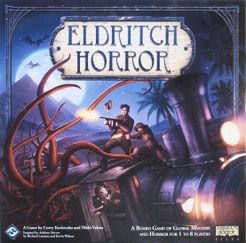
Arkham Horror was the original version of this game, released in 2005, where you ran around Arkham to try and stop the invasion of the hentai gods before their squadrons of flying penis monsters took over the city, and from there the world. After a few expansions, some of which turned this reasonably good game into a pile of smoking dogshit (looking at you, Dunwich), a new version was built around the same gameplay concepts--run around, fight off the hordes of waggling dicks, and figure out how to stop the elder god from either spawning or just ending all life on the planet.
This one, Eldritch Horror, worked better from the start just by having your investigators travel all over the world, since it took a stretch of the imagination to think Cthulhu or Azathoth or whoever would dump all their forces into the one city where anyone knew about them and gave enough of a shit to fight back. It was also designed to have a more streamlined gameplay process; things happen that involve the alternate dimensions famous in the Cthulhu mythos, but you don't travel there and move according to special rules, nor do different characters move different distances, and everyone has two actions per turn to handle anything they want to do--movement, acquiring items, resting, etc. Also, your stats are your stats; the min-maxing every turn, while sometimes useful, is more number crunching than most people need. Five base stats (which can still go up or down, depending on what happens) is plenty.
When you look at the game, and get used to the turn flow, it seems like it should go much faster than Arkham, which was a major selling point of the game. There are only three turn phases instead of five, there's no monster pile on the side that keeps adding to your odds of being utterly annihilated... there's just less to keep track of in general. Your action options are limited and easy to grasp: move, get a ticket so you can move farther, use your influence to buy stuff, rest to regain health and sanity, or trade with another investigator. (Some cards or investigator abilities add more things you can spend actions on, but those are equally easy to understand.) They even have bank loans available so that if you totally flub your influence roll to buy assets, you can still take on debt to get something, assuming all the risk involved (read: mob hit squads). It's designed better on a core level than Arkham.
And yet... this is still a game where five competent gamers can take three hours to finish, which is not really an improvement. Nor are you getting a ton of turns in during that time, maybe seven or eight total. And five players is not excessive; it plays up to eight, which is not recommended. It's like being used to driving somewhere with your grandma, then getting to ride with your brother, which is a more exciting trip that fractures quantum mechanics and somehow ends up taking just as long. That's unfortunate, too, because Eldritch Horror probably benefits more from extra investigators in terms of your odds of winning than its predecessor.
If you've never played either of these games, Eldritch Horror is probably the one you'll like more. It's easier to learn and understand, with fewer marginally useful mechanics. There's more story written into the cards, and less of a requirement that you have investigators with the best possible stats for whatever they're trying to do. It is, in short, an improvement in the you would expect a new version of an older game to be. But you do need to expect this game to take a few hours until you're experienced enough to tear through the encounter and mythos phases.
Score: Thirteen detached tentacle suckers laying dead on a cobblestone road out of nineteen
No, it's not a new game. You think I'm trying to be competitive with Shut Up & Sit Down or something?
Anyway. CTHULHU BITCHES
Arkham Horror was the original version of this game, released in 2005, where you ran around Arkham to try and stop the invasion of the hentai gods before their squadrons of flying penis monsters took over the city, and from there the world. After a few expansions, some of which turned this reasonably good game into a pile of smoking dogshit (looking at you, Dunwich), a new version was built around the same gameplay concepts--run around, fight off the hordes of waggling dicks, and figure out how to stop the elder god from either spawning or just ending all life on the planet.
This one, Eldritch Horror, worked better from the start just by having your investigators travel all over the world, since it took a stretch of the imagination to think Cthulhu or Azathoth or whoever would dump all their forces into the one city where anyone knew about them and gave enough of a shit to fight back. It was also designed to have a more streamlined gameplay process; things happen that involve the alternate dimensions famous in the Cthulhu mythos, but you don't travel there and move according to special rules, nor do different characters move different distances, and everyone has two actions per turn to handle anything they want to do--movement, acquiring items, resting, etc. Also, your stats are your stats; the min-maxing every turn, while sometimes useful, is more number crunching than most people need. Five base stats (which can still go up or down, depending on what happens) is plenty.
When you look at the game, and get used to the turn flow, it seems like it should go much faster than Arkham, which was a major selling point of the game. There are only three turn phases instead of five, there's no monster pile on the side that keeps adding to your odds of being utterly annihilated... there's just less to keep track of in general. Your action options are limited and easy to grasp: move, get a ticket so you can move farther, use your influence to buy stuff, rest to regain health and sanity, or trade with another investigator. (Some cards or investigator abilities add more things you can spend actions on, but those are equally easy to understand.) They even have bank loans available so that if you totally flub your influence roll to buy assets, you can still take on debt to get something, assuming all the risk involved (read: mob hit squads). It's designed better on a core level than Arkham.
And yet... this is still a game where five competent gamers can take three hours to finish, which is not really an improvement. Nor are you getting a ton of turns in during that time, maybe seven or eight total. And five players is not excessive; it plays up to eight, which is not recommended. It's like being used to driving somewhere with your grandma, then getting to ride with your brother, which is a more exciting trip that fractures quantum mechanics and somehow ends up taking just as long. That's unfortunate, too, because Eldritch Horror probably benefits more from extra investigators in terms of your odds of winning than its predecessor.
If you've never played either of these games, Eldritch Horror is probably the one you'll like more. It's easier to learn and understand, with fewer marginally useful mechanics. There's more story written into the cards, and less of a requirement that you have investigators with the best possible stats for whatever they're trying to do. It is, in short, an improvement in the you would expect a new version of an older game to be. But you do need to expect this game to take a few hours until you're experienced enough to tear through the encounter and mythos phases.
Score: Thirteen detached tentacle suckers laying dead on a cobblestone road out of nineteen
Friday, July 28, 2017
Dave Reviews: A Game So Bad It's Not Even A Fucking Game, What The Fuck
Shahrazad
There are times, no matter your job or hobby, when something comes to your attention that's so bad, that is such an egregious misuse of human capital, putting it aside and not making use of it doesn't seem like an acceptable option. However small your influence on the world--and it doesn't get much smaller than what I have here--you are compelled to use it to guard other people from wasting even a minute of their precious time left on this Earth on something which should have been set alight the moment it came off the production line.
Ladies and gentleman, this is Shahrazad.

It looks really nice, right? The art is very good, I won't deny that. If you wanted a bunch of tiles to use as small, attractive coasters, you could do worse than the game pieces in Shahrazad.
Thus ends our compliments section.
Let's start with the theme. You're telling stories. This makes sense, since the aesthetic is clearly ripped off from the myth of FUCKING SCHEHERAZADE, NOT SHAHRAZAD, IT'S NOT COPYRIGHTED, YOU CAN USE THE ACTUAL FUCKING NAME, OK? Except maybe it's better her name wasn't tainted by this trash pile, because you don't tell shit for stories. You put tiles down that refer to parts of stories, but there's not even anything on the back. If it had a story that ran from tile to tile, maybe you could get an extra three minutes of mild amusement flipping the tiles and reading them after playing.
It's not even the first game to use 'Shahrazad' as a name that points towards the mythical figure. Magic had a card named that, down to the letter. It's not a particularly egregious issue there, though, because it was part of the Arabian Nights set and the card's effect didn't have anything to do with the myth. So these fucking people didn't just come up with a dogshit non-game, they straight up swiped the off-brand name for Scheherazade from somewhere else.
As for the 'game': There are twenty-two story tiles numbered 0-21, of four different colors. You have two goals: line them up so any tiles that touch also go up numerically as you move left to right, and also try to make as many tiles of the same color touch as possible. (Tiles are placed in staggered fashion so that each tile can touch two from the columns to its left and right.) The color strings or blocks earn you points; having your stories go in numerical order and avoiding gaps in the tiles keeps you from losing points.
The game is scored on a sliding scale. You play two rounds, with a maximum of twenty-two points per round possible (having all the tiles of each color touching, with no penalties for borking the number ascension or leaving gaps in the lines). If you play with two people, 35+ is required for the highest ranking. If you play alone, 40+ is required. Since there's a limit to how much two players can communicate, the lower score for them makes sense... except they're also limited to a maximum of three tiles per column, whereas someone playing alone can use four. Thus, if you're solo, you can just create a line for each color and place or swap tiles as needed to keep their stories in order. It's possible for a very bad draw to leave you unable to finish a perfect round, but only needing 40 out of 44 points, it's extremely unlikely that you'll ever end up with less than the highest ranking once you figure this out.
Alright, so maybe the single-player rules were inserted as a way to give it a little more playability than if it was advertised solely as a two-player game. That happens all the time in the industry, right? How many games have 'variants' so you can play with only two people, even though it says on the box it fits from two to whatever? How many are simply not that good with certain numbers of players? It's an understandable decision.
Except the game is still completely solvable with two people. The only things that make it harder are a) the fact both people need to know the puzzle, and b) the deck of tiles runs out a little earlier, and you can only swap a tile with one in your hand if there's another one you can draw. The rule that you can only use three columns is a bunch of arbitrary bullshit; if anything it should be the other way around, with that limitation placed on a solo player, since that player has an easier time of it. But once you figure out how to place the tiles, with three columns or four, none of that matters. There's a correct placement for every tile if you want a max score, and if you know what that is, there is zero reason to experiment with anything else. You can't do better, and you don't have an opponent to outmaneuver. The game's done. There's nothing else to do.
Maybe the reason I keep seeing glowing (or at least positive) reviews about this game is that it would take longer to solve if you only play with two people. The reviewers didn't play long enough to realize just how dead the game becomes once you figure it out. I've written a lot of reviews for the store where I work--I started putting them here because I wanted to swear--so I understand how an opinion can be formed which would have been altered by just a bit more information. And the one very, very mild thing the designers did well is create something that does take a little effort to solve while rarely, if ever, being prone to bad draws screwing over the players. That can look like a reasonably good game.
But holy fucking shit, this thing is a travesty. If I was looking for an industry job and this was the only thing on my resume, I'd hand them a blank sheet of paper.
Score: Two mythical figures weeping in the pages of the books that are actual, competent creative works, unlike this shit, out of seventeen. Both of them like the pictures.
There are times, no matter your job or hobby, when something comes to your attention that's so bad, that is such an egregious misuse of human capital, putting it aside and not making use of it doesn't seem like an acceptable option. However small your influence on the world--and it doesn't get much smaller than what I have here--you are compelled to use it to guard other people from wasting even a minute of their precious time left on this Earth on something which should have been set alight the moment it came off the production line.
Ladies and gentleman, this is Shahrazad.
It looks really nice, right? The art is very good, I won't deny that. If you wanted a bunch of tiles to use as small, attractive coasters, you could do worse than the game pieces in Shahrazad.
Thus ends our compliments section.
Let's start with the theme. You're telling stories. This makes sense, since the aesthetic is clearly ripped off from the myth of FUCKING SCHEHERAZADE, NOT SHAHRAZAD, IT'S NOT COPYRIGHTED, YOU CAN USE THE ACTUAL FUCKING NAME, OK? Except maybe it's better her name wasn't tainted by this trash pile, because you don't tell shit for stories. You put tiles down that refer to parts of stories, but there's not even anything on the back. If it had a story that ran from tile to tile, maybe you could get an extra three minutes of mild amusement flipping the tiles and reading them after playing.
It's not even the first game to use 'Shahrazad' as a name that points towards the mythical figure. Magic had a card named that, down to the letter. It's not a particularly egregious issue there, though, because it was part of the Arabian Nights set and the card's effect didn't have anything to do with the myth. So these fucking people didn't just come up with a dogshit non-game, they straight up swiped the off-brand name for Scheherazade from somewhere else.
As for the 'game': There are twenty-two story tiles numbered 0-21, of four different colors. You have two goals: line them up so any tiles that touch also go up numerically as you move left to right, and also try to make as many tiles of the same color touch as possible. (Tiles are placed in staggered fashion so that each tile can touch two from the columns to its left and right.) The color strings or blocks earn you points; having your stories go in numerical order and avoiding gaps in the tiles keeps you from losing points.
The game is scored on a sliding scale. You play two rounds, with a maximum of twenty-two points per round possible (having all the tiles of each color touching, with no penalties for borking the number ascension or leaving gaps in the lines). If you play with two people, 35+ is required for the highest ranking. If you play alone, 40+ is required. Since there's a limit to how much two players can communicate, the lower score for them makes sense... except they're also limited to a maximum of three tiles per column, whereas someone playing alone can use four. Thus, if you're solo, you can just create a line for each color and place or swap tiles as needed to keep their stories in order. It's possible for a very bad draw to leave you unable to finish a perfect round, but only needing 40 out of 44 points, it's extremely unlikely that you'll ever end up with less than the highest ranking once you figure this out.
Alright, so maybe the single-player rules were inserted as a way to give it a little more playability than if it was advertised solely as a two-player game. That happens all the time in the industry, right? How many games have 'variants' so you can play with only two people, even though it says on the box it fits from two to whatever? How many are simply not that good with certain numbers of players? It's an understandable decision.
Except the game is still completely solvable with two people. The only things that make it harder are a) the fact both people need to know the puzzle, and b) the deck of tiles runs out a little earlier, and you can only swap a tile with one in your hand if there's another one you can draw. The rule that you can only use three columns is a bunch of arbitrary bullshit; if anything it should be the other way around, with that limitation placed on a solo player, since that player has an easier time of it. But once you figure out how to place the tiles, with three columns or four, none of that matters. There's a correct placement for every tile if you want a max score, and if you know what that is, there is zero reason to experiment with anything else. You can't do better, and you don't have an opponent to outmaneuver. The game's done. There's nothing else to do.
Maybe the reason I keep seeing glowing (or at least positive) reviews about this game is that it would take longer to solve if you only play with two people. The reviewers didn't play long enough to realize just how dead the game becomes once you figure it out. I've written a lot of reviews for the store where I work--I started putting them here because I wanted to swear--so I understand how an opinion can be formed which would have been altered by just a bit more information. And the one very, very mild thing the designers did well is create something that does take a little effort to solve while rarely, if ever, being prone to bad draws screwing over the players. That can look like a reasonably good game.
But holy fucking shit, this thing is a travesty. If I was looking for an industry job and this was the only thing on my resume, I'd hand them a blank sheet of paper.
Score: Two mythical figures weeping in the pages of the books that are actual, competent creative works, unlike this shit, out of seventeen. Both of them like the pictures.
Tuesday, July 25, 2017
Dave Reviews: A Game That's About, Essentially, Where Jerky And Burgers Come From
Great Western Trail
Score: Eleven jumbo bags of Great Value peppered beef jerky out of twelve.
The only surprise about seeing it's been a little over two years since the last post is that wasn't a hell of a lot longer. So I figured, if I'm going to try this again, I may as well get off to a positive start, and what's more positive than games about giant slabs of beef?

NOT THAT BEEF

NOT THAT BEEF
Yes, thank you.
The whole idea behind Great Western Trail is that you're a cattle rancher from Texas trying to sell cattle in Kansas City and locations westward. Like any good rancher, you want victory points more than money, because victory points indicate the joy of your work that goes beyond mere capitalist interests. But the stationmaster in Kansas City is all, "Fuck your victory points," because he's a joyless prick, so as the game progresses it's necessary to sell better and better herds in order to make it worth shipping them farther west if you don't want them to be stuck in KC.
This is a game that's fairly easily learned, but not easy to describe without explaining how it works, so here goes: You start out with a cowboy, a train, and a deck of cattle cards.
- The deck is what you draw from to create the herd that will be sold once you make it to KC; your goal here is to have as many different types of cattle in your hand as possible, because each type only counts once.
- The cowboy moves up to four spaces (this can be increased later), and can make use of whichever building he stops on each turn. Important note: only spaces with something on them (buildings or hazards) count against the movement limit, so early on it's possible to run your cowboy from Texas to KC in just a couple of turns. As the game progresses and buildings are put up in the blank spots on the board, the cowboy can't go as far each turn unless you upgrade his movement.
- The train is, I guess, something you're invested in as a cattle rancher? Certain buildings will let you move your train car forward, and certain abilities can force it back as well. The farther forward it is, the cheaper it is to ship your cattle to more distant cities.
At the beginning of the game, there are only seven buildings on the board. These allow for the basic mechanics--hiring more workers, putting up buildings, trading in cattle for money along the way (this is the main method for manipulating your hand in order to have different cattle types when you reach KC), buying more cattle, etc. Right away you're forced to prioritize. Do you stop in to hire workers? Put up a building while there are more spaces available? Four of the seven neutral buildings let you trade in cattle for money and draw new cards. How necessary is that for you? If you have three 2s and a 1--the best possible hand with the base deck--do you race to KC for the quick money and make use of more buildings on the next trip through?
Prioritization gets more complicated as the game goes along and the board fills... kind of. You end up with more options overall as you place buildings, but you're not allowed to use your opponents' buildings; all they do is slow your movement and, in some cases, make you pay the player who owns that building a coin or two. You also never see buildings that let you hire more workers or construct more buildings apart from the neutral ones that are available from the start. So you end up having to decide what you can (or need to) accomplish to max out the money and points you're earning while not having that many more options compared to the start, unless you focus hard on hiring craftsmen and putting up buildings every chance you get.
That doesn't mean you're working around the same few goals the whole game, though, which brings us to the strength/weakness of the game: the absolutely fucking bananas number of ways to score points. You don't count points until the end, but once you're there, there are eleven different things to score. They give you a score pad, but still, that's a lot of possibilities to keep track of while you're playing. You can't possibly chase them all, but you'll have to go for more than one to have a chance, so sometimes a strategy might come down to how many different possibilities you can keep track of, in order to take advantage of the ones that become most readily available. It could be owning station master tokens, fulfilling more objective cards, buying better cattle and pulling together more VPs at the end by hitting the furthest-west stations, and it could also involve synergy between the goals you're chasing or just getting stuff that all adds up to a bunch of points on their own.
You know what, though? It works. It doesn't feel as overwhelming as it could, even as a first time player, although being a board game vet helps a lot. This might not be the game you want to convince your boyfriend that board games are actually a lot of fun and he should play them with you more often, unless you only like two-hour-plus games that require mucho consideration to maximize the effects of each turn. At least then you're being honest with him about what he'll be getting into playing with you.
Score: Eleven jumbo bags of Great Value peppered beef jerky out of twelve.
Subscribe to:
Comments (Atom)